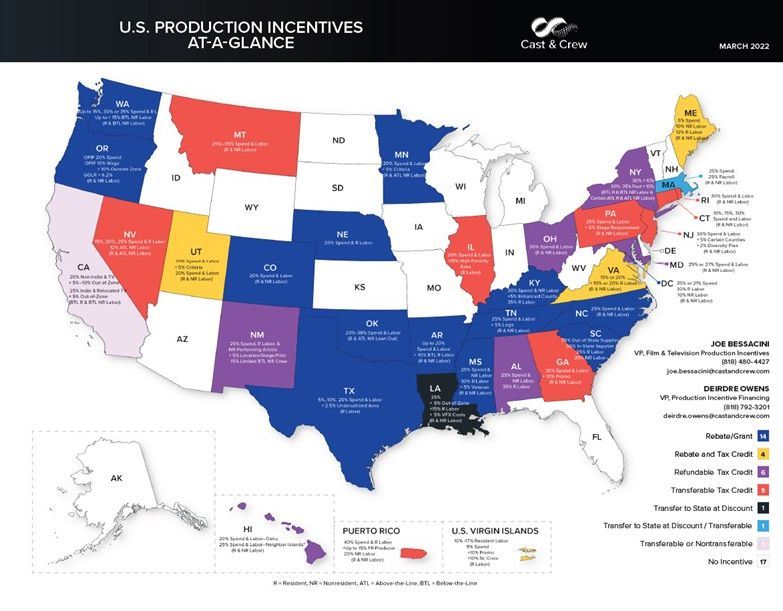
There are approximately 34 states which have some sort of incentive program let's make Michigan one of them
Articles and Information about tax credits
Here you will find articles for our archives detailing work in Michigan, tax credits and
what its like in other states with a film program
2025 Articles
IL Tax Credit changes Nov 2025
Reel Chicago
In a significant win for the state’s film and television community, the Illinois General Assembly passed a sweeping expansion of the Illinois Film Production Services Tax Incentive program, reinforcing Illinois’ growing reputation as one of the country’s most production-friendly states. The bill, SB 1911, now heads to Governor J.B. Pritzker’s desk for his expected signature.
According to a statement released by Christine Dudley, Executive Director, of the Illinois Production Alliance (IPA), the legislation marks a crucial step in strengthening Illinois’ ability to attract more film, television, and commercial projects, supporting thousands of local jobs and small businesses statewide.
“We congratulate everyone who worked so hard to get this done and thank the legislators who recognize how valuable production is to our state’s economy and creative identity,” Dudley said in the statement.
Key Enhancements Under SB 1911
· Increased Tax Credit for Local Labor: Productions will see an increase in their tax credit for labor when they hire Illinois residents, going to 35% (up from 30%).
· Increased Tax Credit for Illinois Vendors: Productions will see an increase in their tax credit when engaging Illinois vendors, going to 35% (up from 30%).
· Expanded Non-Resident Inclusion: Now, up to 13 non-residents other than actors can be included in the film credit calculation, with a 30% tax credit for those salaries on the first $500,000 each. This is up from 9 positions in prior legislation.
· Actor Credit Adjustments: Productions hiring non-resident actors continue to receive a 30% tax credit on those salaries up to the first $500,000 per, with the number of eligible actors depending on the project’s budget:
· 4 actors included for projects budgeted at under $20MM
· 5 actors included for projects budgeted between $20MM – $40MM
· 6 actors included for projects budgeted at over $40MM
Note: for the purposes of calculating non-resident compensation for a series, the limit is applied on a per-episode basis.
· Regional Production Bonus: For productions filming outside of Cook, DuPage, Kane, Lake, McHenry, and Will Counties, an additional 5% credit is offered on labor expenditures for hiring Illinois residents.
· Relocating Series Incentive: A television series relocating to Illinois will receive an additional 5% credit on its Illinois production spending.
· Green Sustainability Incentive: Productions with a certified “green” sustainability plan will receive an additional 5% credit on their Illinois production spending.
· Airline Credit Addition: Airline tickets now qualify as a production expense in tax credit calculations, when purchased from an airline with their corporate headquarters domiciled in Illinois.
The Illinois Production Alliance credited the passage to a strong collaboration between state leaders, labor unions, and industry partners, as well as the IPA’s own two-year advocacy campaign led by its board, government affairs team, and the Motion Picture Association (MPA).
Special thanks were extended to Governor J.B. Pritzker, Senate President Don Harmon, House Speaker Chris Welch, and legislators Elgie Sims, Mattie Hunter, Cristina Castro, Curtis Tarver, Margaret Croke, and Kimberley DuBuclet for their leadership and support.
“This legislation allows Illinois film, television, and commercial production to move to the next level,” Dudley added, calling the moment “a tremendous victory for the state’s creative economy and its people.”
https://reelchicago.com/article/new-details-emerge-about-sb-1911-tax-incentives/
Hollywood Jobs Are Disappearing 10 December 2025
WSJ
Work in Los Angeles’s entertainment industry is evaporating. A desire to cut production costs, changing viewer habits, and competition from other filming locations are all contributing to a dramatic reduction in Hollywood jobs. WSJ’s Ben Fritz explains how the city’s creative middle class is bearing the burden. Jessica Mendoza hosts.
Jessica Mendoza: When I think about the people who make up Hollywood, I think of action stars, red carpet icons, A-list directors, and big studio bosses. But the vast majority who work in the industry have jobs that are way less glamorous.
Ben Fritz: You wouldn't know their names, but these are the people who actually make films and TV shows mostly behind the scenes.
Jessica Mendoza: My colleague Ben Fritz covers the entertainment industry.
Ben Fritz: They're assistant directors. They're grips who hang the lights. They're sound recordists. They're animators. They're working writers. They're production managers. There are so many jobs that make a movie and TV show work. Just think of the end credits at the end of any film. If you ever actually sit through them, they're really long. Right? There's hundreds and hundreds of names.
Jessica Mendoza: These are the names that make up the backbone of show business, Los Angeles's creative middle class. Ben's been talking with a lot of these workers lately, and things haven't been good. What sort of things have they been telling you?
Ben Fritz: They've been telling me that there's not nearly as much work as there used to be, just bottom line. And it's not one of those things where it's been slowly falling and slowly falling. It's not like the frog boiling in the water. It's a dramatic drop-off. It happened very suddenly. Broadly speaking, in LA, if you're involved in the entertainment industry, this has been a very rough two years. Very, very rough.
Jessica Mendoza: Ben, you've lived in LA for 20 years now. So this isn't the first time you've seen Hollywood go through a downturn. How does this compare to what you've seen before?
Ben Fritz: Oh, as far as anxiety about the future of entertainment and people's ability to work in entertainment, this is the worst since I've ever been here, by far. Not even close.
Jessica Mendoza: Welcome to The Journal, our show about money, business, and power. I'm Jessica Mendoza. It's Monday, November 10th. Coming up on the show, Hollywood in crisis.
Ben Fritz: Hey, Thomas.
Thomas Curley: Hi. You out front?
Ben Fritz: Yeah. Yes. We're at your gate.
Thomas Curley: All right. I'll be right there.
Ben Fritz: Okay.
Jessica Mendoza: Late last month, Ben drove up to Sylmar, a northwest suburb of Los Angeles. A lot of people who work in film and TV live in this area. Houses are more affordable, and the big studios are within driving distance. Ben was there to visit a member of Hollywood's creative middle class, Thomas Curley, a production sound mixer.
Thomas Curley: Welcome.
Ben Fritz: Hey. Good to see you, Thomas.
Thomas Curley: Yeah. You too.
Jessica Mendoza: Walking up to Thomas's house, one of the first things Ben saw is a big, beautiful orange tree.
Ben Fritz: Did you plant this orange tree, or is it here?
Thomas Curley: No. This was here when I moved here. A lot of this is kind of why I bought the place. So I just really like the atmosphere.
Ben Fritz: The landscaping? Yeah. It looks great.
Thomas Curley: Yeah. Yeah.
Jessica Mendoza: Thomas bought his house in 2023 for $650,000, but the recent downturn in LA has hit him hard. He's barely worked since April of last year. Now, his mortgage is in forbearance. He never imagined himself in this situation.
Thomas Curley: I thought that this house, if the career didn't pause, that I was living below my means.
Ben Fritz: Right.
Thomas Curley: I could have theoretically afforded a house twice that much if work never stopped. There was always kind of a thought in the back of your head that this can all stop, but I didn't think that that was likely.
Jessica Mendoza: He didn't think it was likely, because the previous decade had been really good for Thomas, and he was successful. His big break came in 2014 on the critically acclaimed indie film Whiplash.
Speaker 4: Five, six, and...
Thomas Curley: They sent me the script, and I'd never read a script faster. It just was blistering on the page, and I was very excited immediately.
Jessica Mendoza: Whiplash follows the story of a young jazz drummer at an elite music conservatory, who becomes obsessed with achieving greatness. The challenge for a production sound mixer like Thomas was capturing the actor's dialogue over live music.
Speaker 4: We got Buddy Rich here.
Jessica Mendoza: Thomas made it work by carefully layering the right amount of prerecorded music along with recording live.
Speaker 5: Welcome to the 87th Oscars. Tonight, we are-
Jessica Mendoza: For his work on Whiplash, Thomas was awarded Hollywood's highest honor.
Speaker 6: And the Oscar goes to Whiplash, Craig Mann, Ben Wilkins, and Thomas Curley.
Thomas Curley: Walking up to the stage, I was just trying not to pass out. I was getting short of breath, and my mouth was dry, and I was getting tunnel vision. Thanks, Mike and Dave, my crew. You guys are awesome.
Ben Fritz: Here's your Oscar. Yeah. You keep it on this bookshelf?
Thomas Curley: Yup.
Ben Fritz: Is there a lot of thinking about where to put an Oscar? Where does one put an Oscar in one's house?
Thomas Curley: My options are kind of limited in this house, but I figured a place of prominence is-
Jessica Mendoza: After he won the Oscar, calls for bigger-budget, longer-term jobs flooded in. Thomas worked on the hit TV show Yellowstone for three seasons. And then in 2022, he got another gig that he thought would last for a long time, with CSI: Vegas.
Thomas Curley: It's kind of the dream job for a production person to be on a pedigreed television show that is almost guaranteed to go for a very long time, and possibly even time it out completely to where I could retire after the show wrapped. If that had gone for 10 years, I would have been set.
Jessica Mendoza: Then in the summer of 2023, everything in Hollywood stopped.
Speaker 7: Hollywood has gone dark tonight. SAG-AFTRA actors have now joined Writers Guild members on strike against the studios.
Ben Fritz: So all of a sudden, production just came to a screeching halt.
Jessica Mendoza: That's my colleague Ben again.
Ben Fritz: And, of course, during a strike, there's no work. If you don't have actors, you don't have writers, you can't make anything.
Jessica Mendoza: What was it that these workers wanted? What were they fighting for?
Ben Fritz: There was a variety of things. Some of it was the basic stuff all workers always want, which is higher pay and better benefits, but they were also very concerned about the effects of artificial intelligence, and they demanded protections against AI stealing their jobs essentially. That was another big issue.
Speaker 8: We are being victimized by a very greedy entity. I am shocked by the way the people that we have been in business with are treating us.
Jessica Mendoza: And what were the studios saying at that time? What was happening then?
Ben Fritz: Well, the studios, of course, were saying that some of these demands were unreasonable, and that they were saying that, "The longer you're on strike and the more you demand, the more danger you're putting this entire industry in as far as how much production is going to get made."
Jessica Mendoza: Finally, in the fall of 2023, after months of negotiations, the unions struck a deal with the studios, and the strikes ended. Many writers, actors, and production workers thought that Hollywood would simply start back up again. And for some, it did, for a while. Thomas went back to work on CSI. But in the spring, the show was canceled, and Thomas found himself unemployed.
Thomas Curley: My phone didn't ring for months. I was reaching out to my network regularly and talking to all my colleagues and friends and seeking out information like we do when we're not working, and there was a lot of speculation. There was a lot of just out-loud wondering about what's going on, and maybe the strikes are still having a ripple effect or something, but that turned into, I didn't work again all year.
Ben Fritz: Nothing was getting going. Nothing was getting going, and people were thinking, "Well, maybe the studios are just being really cautious after the strikes."
Jessica Mendoza: Ben spoke to dozens of workers, including animators, writers, and production managers, who all told him something similar.
Ben Fritz: In the past, sometimes there have been slow periods, but they don't last too long, and the lesson everybody's learned is just be patient, make sure you have some savings to get through a tough time, and the jobs will come back soon enough. But it's been two years, and the situation really hasn't changed at all. If anything, it's gotten slightly worse.
Jessica Mendoza: So it sounds like Thomas and these other workers you talked to, they really just thought things would go back to normal after the strikes ended in 2023, even if it might take a couple years.
Ben Fritz: Yes. That's exactly what they thought. I think people didn't realize that these broader macroeconomic trends coming down the road were about to hit them like a semitruck.
Jessica Mendoza: Thomas and the rest of Hollywood's creative middle class thought that the studios were just easing back in after the strikes ended. But Ben says, the strikes had created an opportunity for studios to rethink the entire business. That's after the break. To understand why Hollywood didn't get back to business as usual, you need to understand what was happening to the industry at the time of the 2023 strikes. The movie business had taken a nosedive when theaters shut down during the pandemic, and audiences never came back in the same way. But more importantly, the TV industry crashed.
Ben Fritz: And TV is really the economic engine of Hollywood. There's a lot more TV shows than movies.
Jessica Mendoza: Back in the late 2010s and early 2020s, investors were betting big on streaming.
Ben Fritz: You would have experienced this. Remember, there were so many TV shows on streaming, you couldn't keep up with them all just a few years ago? It was all about growth. Wall Street just wanted to see these streaming services like Disney+ and Apple+ and HBO Max to grow, grow, grow, grow, grow, just like any young tech company. That's all they cared about.
Jessica Mendoza: By 2022, the U.S. market was saturated. America seemed streamed out. That spring, Netflix said that for the first time in over a decade, it lost subscribers in the first quarter. Suddenly, instead of growth, investors wanted to see studios turn a profit, and the studios figured the easiest way to do that is to cut costs, to just make less stuff.
Ben Fritz: The streaming bubble was popping in 2023, and the strikes provided an opportunity for the studios to completely reset how much they were making. In Hollywood, productions take a long time to get going, and you can't just turn on a dime. But when nothing was happening for several months, it was actually an opportunity for the studios to really rethink how much they were making. And once they restarted in late 2023, when the strikes were over, they restarted at a much lower level than they'd been at before them.
Jessica Mendoza: One data firm found that from 2022 to 2025, the number of major studio productions that started shooting in the U.S. dropped by more than 40%.
Ben Fritz: And think about that. Imagine if there was just 40% less work to do in any industry. Right? It would feel like a depression hit out of nowhere.
Jessica Mendoza: A big movie can employ over 1,000 people for months, and a TV show can employ hundreds for even longer. So with fewer productions, jobs vanished.
Ben Fritz: Well, according to the Bureau of Labor Statistics, at the end of 2022, so just before the strikes, there were 142,000 people who were working in the motion picture industry in Los Angeles County. At the end of 2024, there were 100,000 people. So that's 42,000 jobs had gone in a span of two years.
Thomas Curley: In the best years, I was making over 200,000.
Jessica Mendoza: With all those jobs gone, people like Thomas are now seeing their incomes plummet.
Thomas Curley: I was actually making double mortgage payments for a while in an effort to pay down my house quicker. And I think this year, 2025, I might be under 20,000 income.
Jessica Mendoza: But one corner of entertainment is booming, user-generated content. Some analysts say audiences are permanently shifting from Hollywood to YouTube and social media. Why couldn't people just shift to working in the creator industry if that's where the money is going, if that's what's blossoming?
Ben Fritz: There's just a lot fewer jobs and a lot fewer well-paying jobs in YouTube and especially in TikTok, even if it's the highest-level professional stuff. Think of a show like Hot Ones, if you've ever watched that on YouTube. That's still being made by way fewer people than make a talk show that's on NBC or whatever. They're just smaller productions.
Jessica Mendoza: And not only do these social media productions hire fewer people, they also don't pay as well.
Ben Fritz: All the jobs making content on YouTube and TikTok are not unionized, and Hollywood is a union town, and the union jobs are the ways that people are able to make a good middle-class living.
Jessica Mendoza: Yeah. It's like, going back to Thomas Curley, it's hard to imagine a YouTube show paying somebody like him $150,000 for a show on YouTube.
Ben Fritz: Yeah. Exactly.
Jessica Mendoza: The industry downturn has been especially hard on Los Angeles. The city was already experiencing a production exodus to places where costs are lower. More and more big-budget movies are shifting production overseas to the UK, Canada, and Eastern Europe. Ben says what's happening in LA reminds him of Detroit, when the auto industry fell apart and thousands of union workers lost their jobs. Just walking around LA, are there signs that you can see that studios are shooting less?
Ben Fritz: Sure. Well, if you go to the studio lots where there are big sound stages, a lot of them are empty. There's just a lot less activity. There's fewer people driving around on golf carts and walking in and out with their costumes and stuff, because not as much stuff is shooting. The way that they measure production activity in LA is how many days of shooting there are, and the level of production activity last year in Los Angeles was the lowest it's been since at least 1995, which is as far back as the data goes.
Jessica Mendoza: 30 years, I guess, except for the pandemic.
Ben Fritz: Yup.
Jessica Mendoza: Wow. Ben, what does this all mean for the future of Hollywood as an industry?
Ben Fritz: It means that Hollywood may not ever come back to the level that it was at before. I mean, certainly, people are always going to want to be entertained. There's no question about that, and there's always going to be a place for the sort of premium, high-quality productions that we're used to getting from Disney and Netflix and so on. But there may be less of it. There may be fewer people working in it, and Hollywood may just be, bottom line, a smaller industry that employs fewer people.
Jessica Mendoza: As for Thomas, he says that if he doesn't get a longer-term gig by the end of this year, he might move out of LA.
Thomas Curley: I'll survive. I'll figure something else out to do with the rest of my life if I have to, but I don't want to.
Jessica Mendoza: Because as hard as the financial loss is, what's most painful to Thomas is that he's no longer getting to do the work that means so much to him.
Thomas Curley: I put everything into this. I put my whole heart and soul into it, and I'm very good at it, and there's nothing that should be stopping me for the next 20 years if I wanted to. They can ask me to do anything anywhere, and I'll make it happen, and I'll make it good. So it's not just that I'm sad that I don't get to turn a wrench anymore. I'm sad that I don't get to create like I used to and help other people create the way they want to. And money is money, but this is more than that. It's part of me.
https://www.wsj.com/podcasts/the-journal/hollywood-jobs-are-disappearing/556a88af-b759-491f-8589-d6aa2d3a432e?UCID=WSJ_SMD_MET_BRA_BND_YBD_NAP_NAP_HJD_STC&utm_medium=paid&utm_source=fb&utm_id=23862285852320105&utm_content=120237040264180106&utm_term=120229190619220106&utm_campaign=23862285852320105
2026 Articles
National Incentive news
Mayor of Kingstown" returning to Pittsburgh for 5th and final season
By Madeline Bartos
January 5, 2026 / 2:57 PM EST / CBS Pittsburgh
"Mayor of Kingstown" is coming back to Pittsburgh to film a fifth and final season.
Paramount+ on Monday announced plans to renew "Mayor of Kingstown" for a final eight-episode season.
The drama, which stars Oscar nominee Jeremy Renner and Emmy winner Edie Falco, centers around the McLusky family in the fictional town of Kingstown, Michigan.
Season 4 wrapped up on Dec. 28, boasting a 100% Tomatometer rating on Rotten Tomatoes.
The newest season showed Renner's character Mike McLusky confronting a gang war and contending with a headstrong new warden, played by Falco.
"Mayor of Kingstown follows the McLusky family – power brokers in Kingstown, Michigan where the business of incarceration is the only thriving industry.
Tackling themes of systemic racism, corruption and inequality, the series provides a stark look at their attempt to bring order and justice to a town that has neither," Paramount+ says.
Paramount+ didn't release any details about the fifth season's storyline or a timeline for its release, but in a Facebook post, the Pittsburgh Film Office said production would be returning to the region soon.
The film office said that the fourth season brought over $95 million to the Pittsburgh area.
"Season 5 is expected to continue local economic prosperity!" the film office wrote.
"Mayor of Kingstown" has filmed several seasons around western Pennsylvania, using communities like Millvale and McKeesport and locations like the 16th Street Bridge and the Western Penitentiary.
When the show returns for production, the Pittsburgh Film Office usually puts out a call for extras.

Older News
Big step forward for legislation that would bring film incentives back to Michigan
By WWJ Newsroom
WWJ Newsradio 950
April 24, 2024
(WWJ) — It’s been nearly a decade since Michigan’s film incentives went away. But a new package of bills took a step forward this week in hopes of bringing the film industry back to the state.
The Michigan Multimedia Jobs Act passed out of the Michigan House Economic Development and Small Business Committee on Tuesday.
The legislation will now head to the full State House for a vote, nine years after former Gov. Rick Snyder ended the state’s film incentives program.
Rep. Jason Hoskins of Southfield, a co-sponsor of the bill, says the act allows for a tax credit designed to promote Michigan-produced films, TV shows and digital streaming productions.
That differs from the previous film incentives program, which offered a rebate to filmmakers. Under the new structure, productions that choose Michigan will receive Michigan-based tax credits, incentivizing producers to spend money on Michigan-based businesses and workers.
“We wanted to make sure that Michigan vendors, Michigan jobs stayed here in the state. So as part of the program, if you are taking advantage of this, you have to use a CPA,” Hoskins told WWJ’s Taylor Dietz.
The proposed film incentives would help more than just filmmakers and creatives, as their companies will hire anything from local caterers and hospitality companies to carpenters and electricians. Groups working on Michigan-based productions will also patronize local restaurants, bars and shops.
Hoskins noted that the proposed legislation was based off what is seen in other states with similar incentives that do a good job of keeping the money within the state.
https://www.audacy.com/wwjnewsradio/news/local/legislation-would-bring-film-incentives-back-to-michigan
  |